Pricing Calculators
Pricing calculators for sellers: what a percentage discount does to the price a buyer pays, and how much of each sale is profit once your costs are taken out. Fees are one half of the question; the price is the other.
Margin and markup are easy to confuse. Margin is profit as a share of the selling price; markup is profit as a share of your cost. A 50% markup is a 33.3% margin, and the profit margin calculator works out both.
What price gives a target profit margin?
price = cost ÷ (1 − target margin)
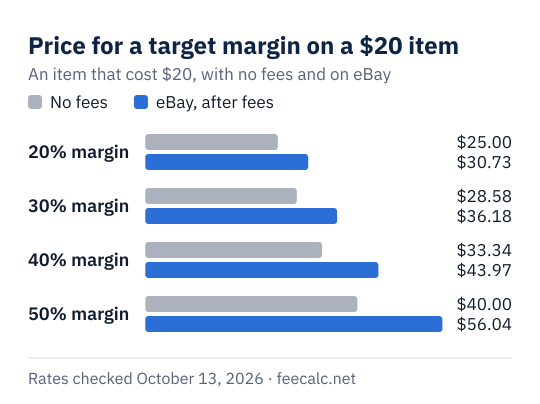
An item that cost $20 needs $25.00 for a 20% margin and $40.00 for 50%. Marketplace fees come out of the price first, so on eBay the same margins need $30.73 and $56.04.
The eBay fee calculator and the other marketplace calculators show the break-even price once you enter your costs. To start from a price you already have, the sale price calculator works out a discount.
All calculators in this category
Questions about pricing
What is the difference between margin and markup?
Both describe the same profit. Margin divides it by the selling price, markup by your cost: buy at $20, sell at $30, and the $10 profit is a 33.3% margin and a 50% markup.
Does a discount change my margin?
Yes, by more than the discount suggests, because your cost stays the same. An item that cost $20 and sells for $40 has a 50% margin; at 25% off it sells for $30 and the margin falls to 33.3%.
How do I price for a margin after marketplace fees?
Find the price whose profit after fees is the margin you want. For an item that cost $20, a 30% margin needs $28.58 with no fees and $36.18 on eBay. Each marketplace calculator here also shows the break-even price once you enter your costs.
Sources
- Wikipedia: Profit margin — definition of gross and net margin (checked October 16, 2026)
- Wikipedia: Markup (business) — markup as a share of cost, and its relation to margin (checked October 16, 2026)
- eBay: Selling fees — official fee page, used for the eBay prices (checked October 13, 2026)